
Drug-discovery models, in context
I contribute to the Ersilia Open Source Initiative, a non-profit building free ML tools for neglected-disease research. My work there is chem-icl.
The idea
Predicting a molecule's toxicity usually means training a fresh model per task. chem-icl skips training: it groups Ersilia model outputs into representation families, selects the best features, and hands a labelled context to TabPFN, a transformer that reasons over it at inference. The context is the input; nothing is fit.
The pipeline
                    ┌─ concat → select ─┐ physchem
SMILES+labels ─group┤  (Isaura)   (≤k)  ├─ concat → TabPFN → P(active)
  into families     └─ concat → select ─┘ learned            (+ RF baseline)
Molecules resolve cheapest-first: local store → cloud lake → a one-off run, cached back. Every model must cover every molecule.
What the benchmark says
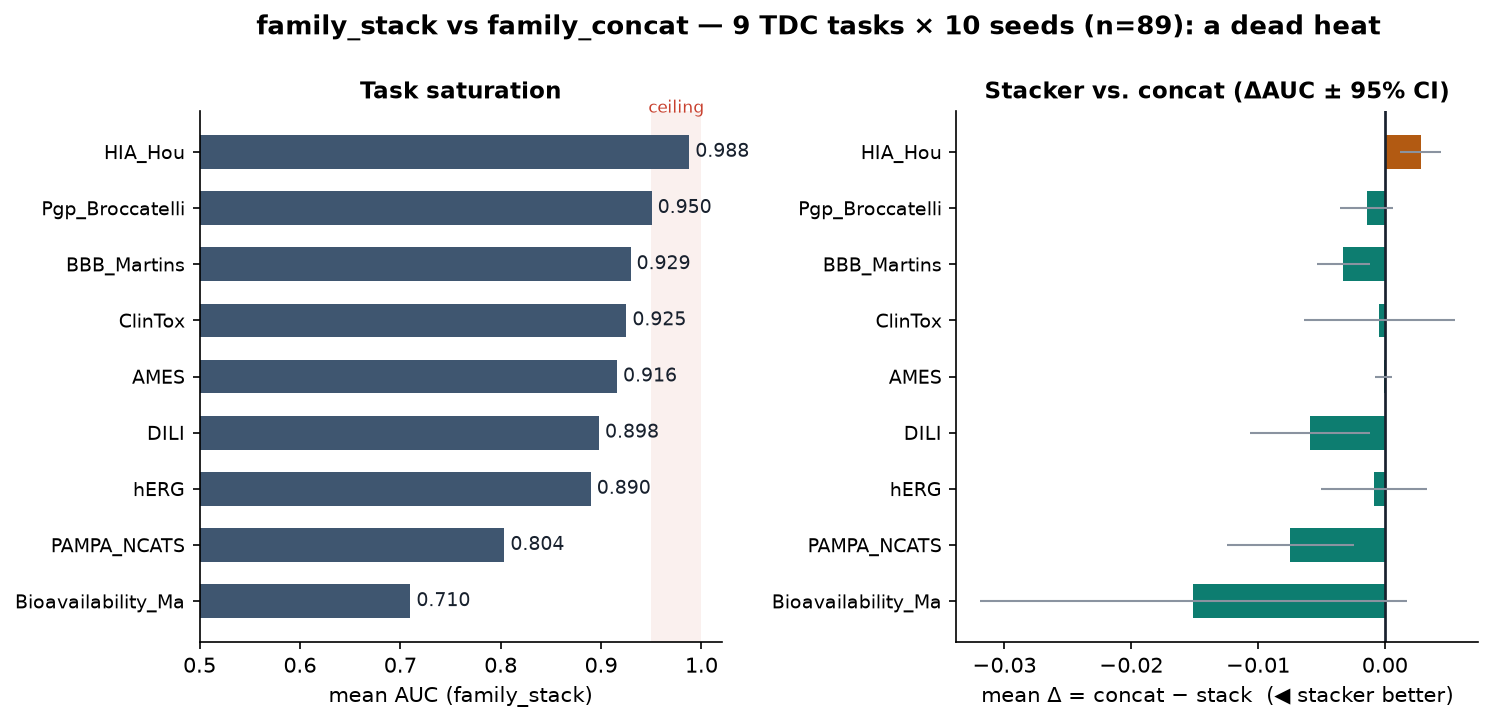
chem-icl ships the simpler concat as default.