Two states of water, made visible
Is liquid water one continuum, or a mixture of two local structures? A century-old debate, because both pictures fit the same bulk data. Unsupervised clustering decides — validated against an observable the clustering never saw.
The method
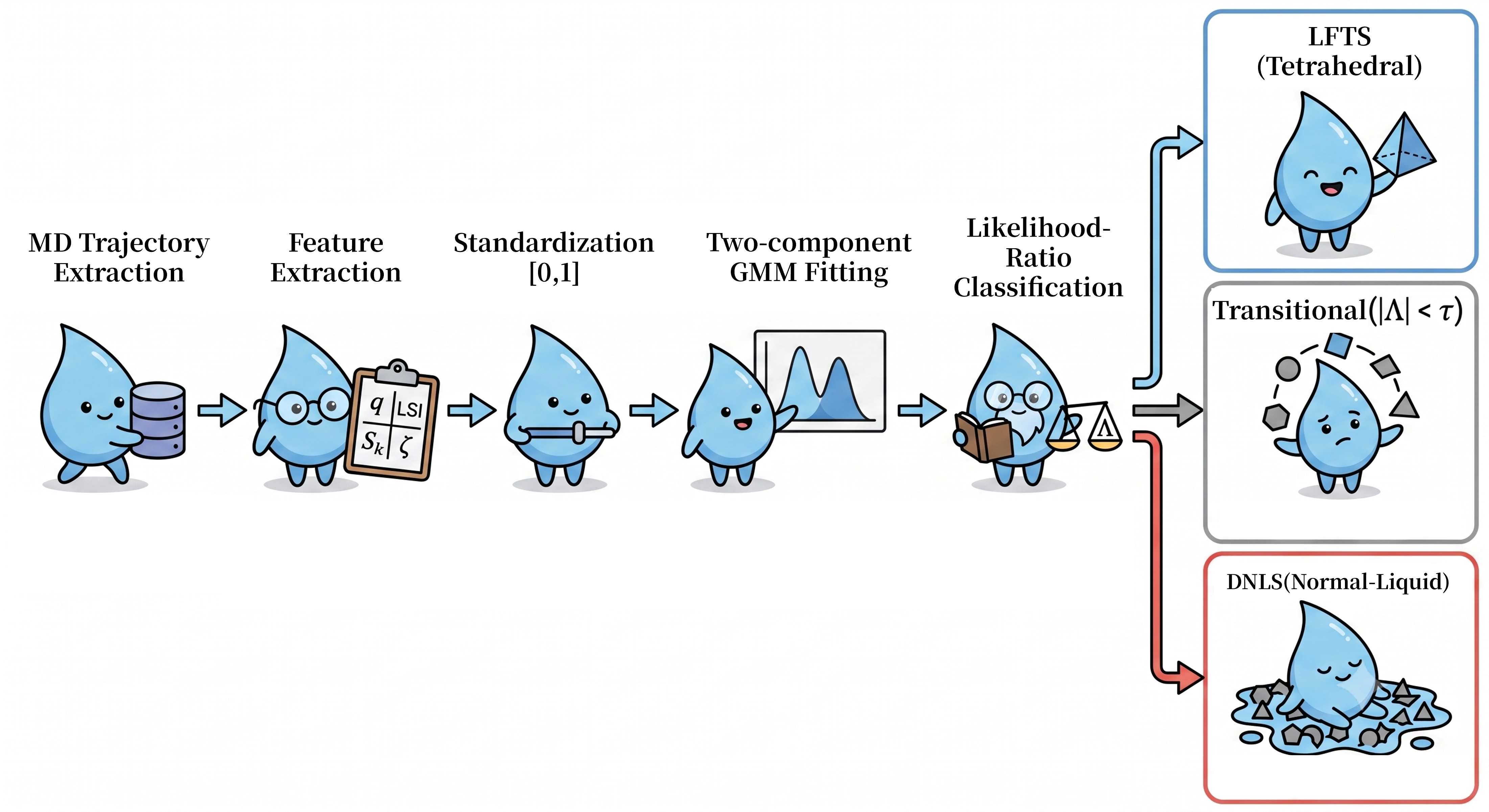
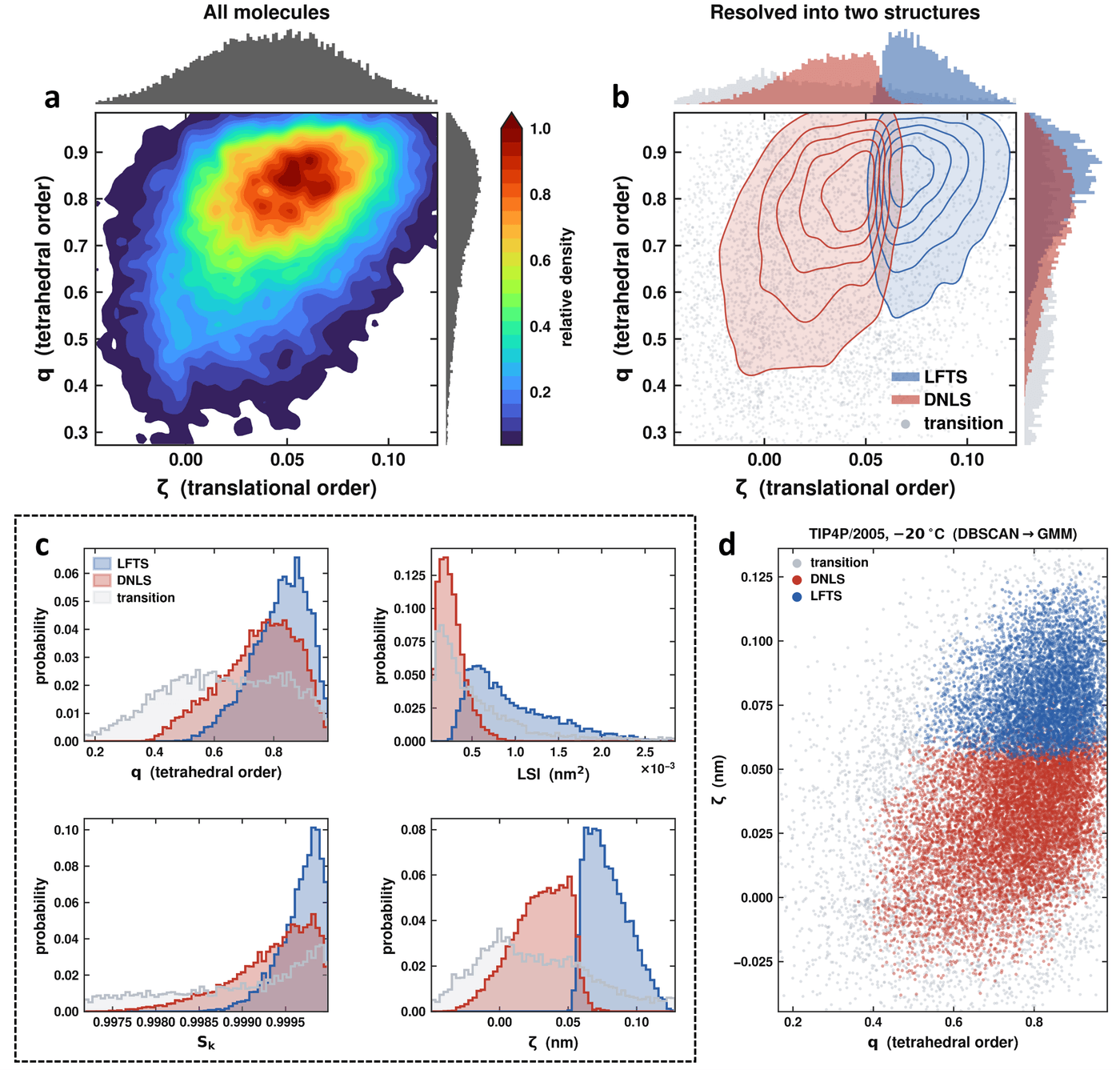
I ran molecular dynamics on TIP4P/2005 and TIP5P water and described each molecule by four order parameters — tetrahedral order q, LSI, Sk, and translational order ζ. A hybrid density-denoising pipeline (DBSCAN → GMM) gave the clearest split: two structurally distinct populations — locally favoured tetrahedral structures (LFTS) and disordered normal-liquid structures (DNLS) — emerge on their own.
The validation
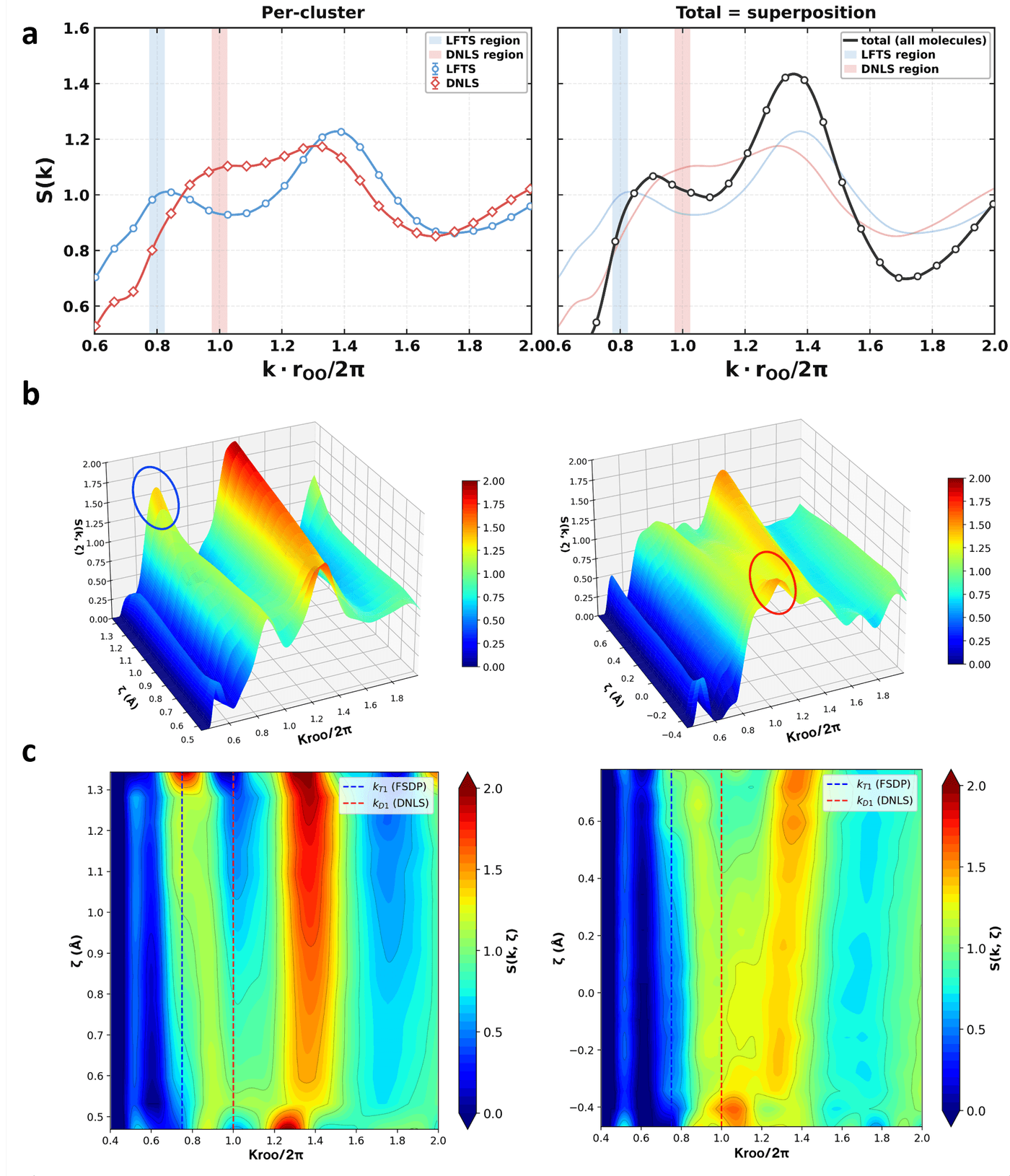
Clusters are easy to draw and hard to trust. So I tested them against something the clustering never saw: the per-cluster oxygen–oxygen structure factor S(k), computed straight from atomic coordinates. The LFTS cluster peaks at kT1 ≈ 0.81, the DNLS cluster at kD1 ≈ 1.05 — exactly where two-state theory predicts. Since clustering and validation share no descriptor, the agreement is model-independent.
S(k) of real water.Generality
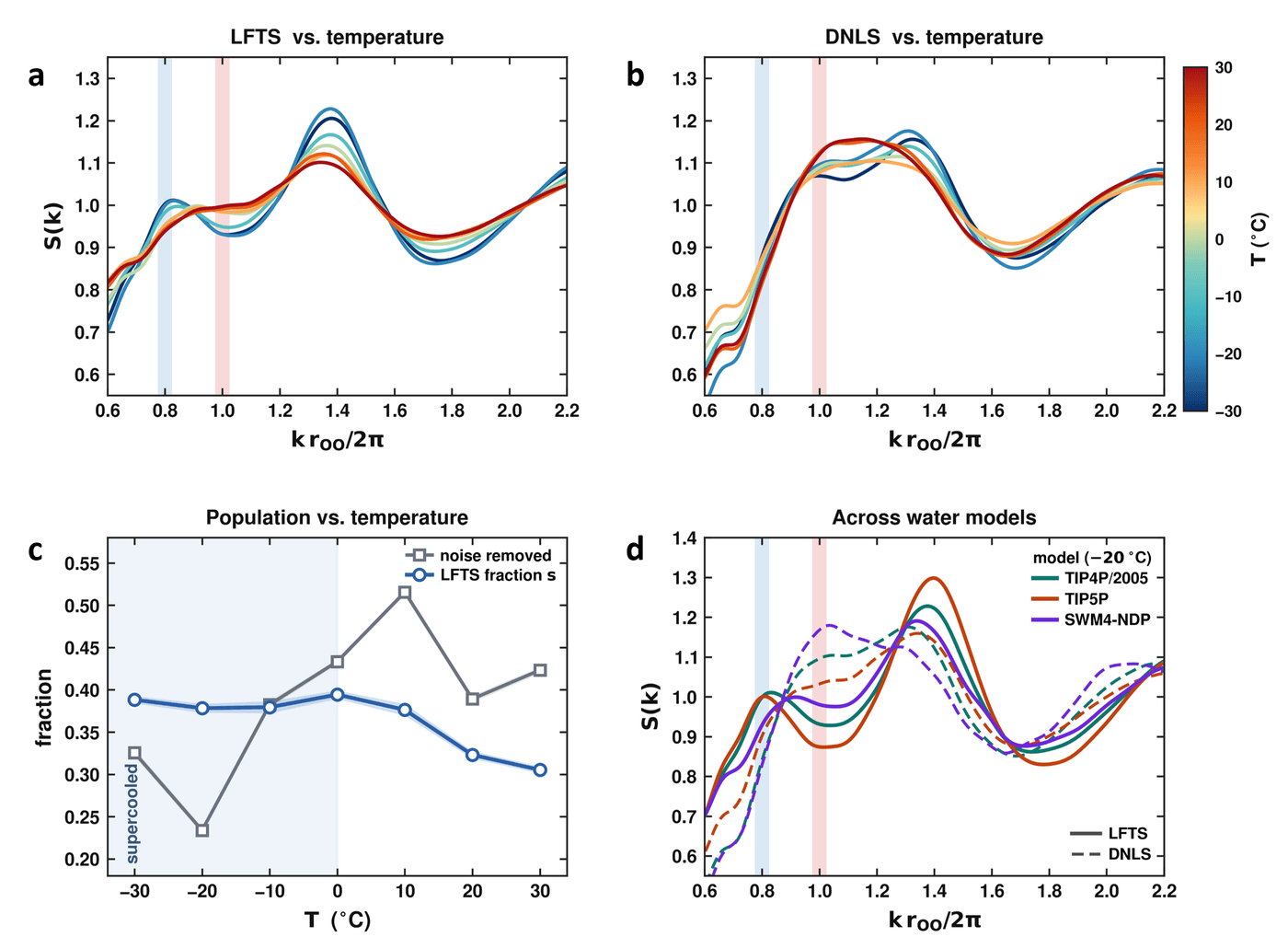
The two-state signature is not an artefact of one model or temperature. It holds from deep supercooling to ambient conditions, and across three independent water models.