Two states of water, made visible
Is liquid water one continuum, or a mixture of two local structures? A century-old debate, because both pictures fit the same bulk data. Unsupervised clustering decides — validated against an observable the clustering never saw.
Is liquid water one continuum, or a mixture of two local structures?
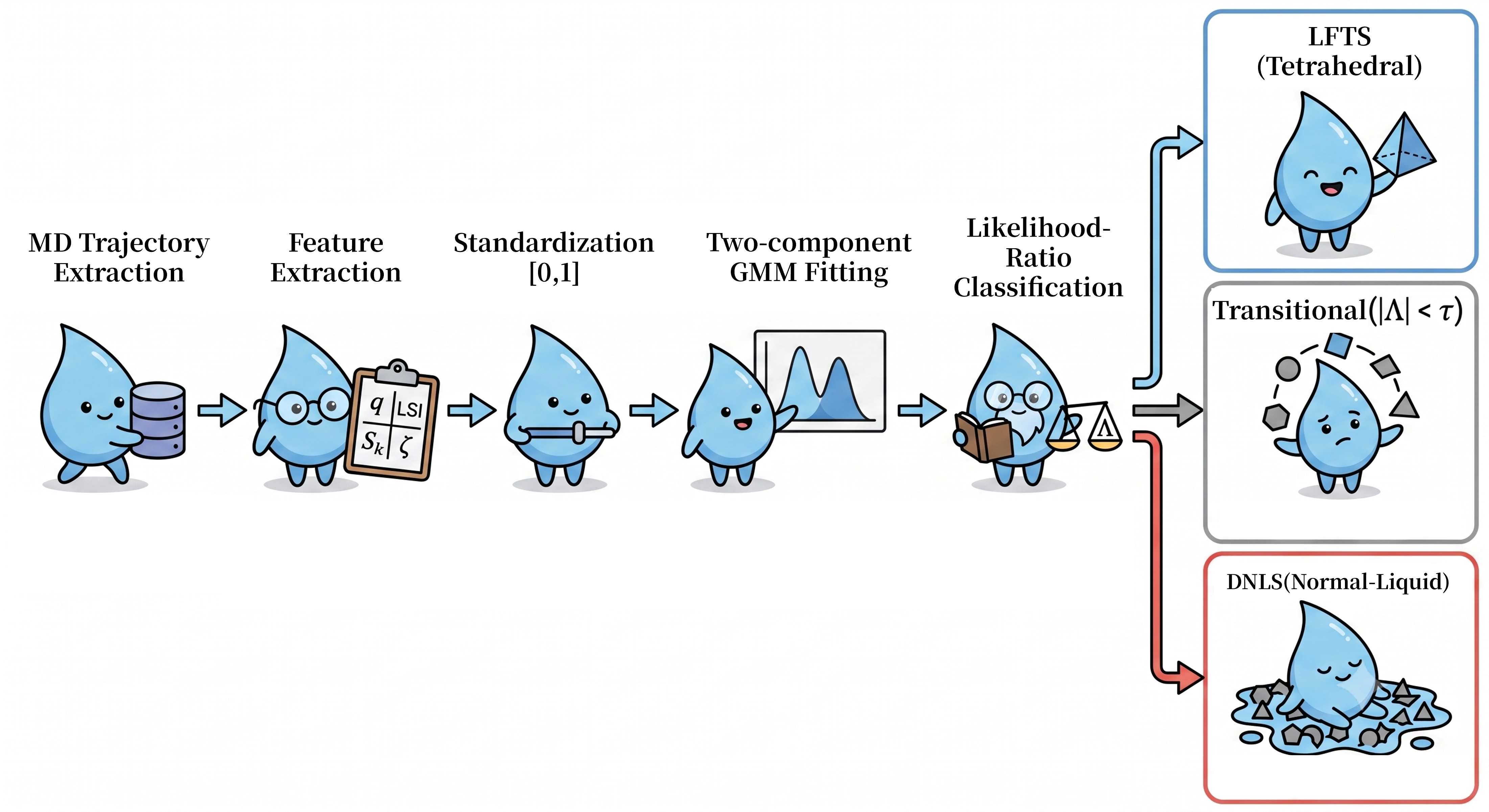
The method
I ran molecular dynamics on TIP4P/2005 and TIP5P1 water and described each molecule by four order parameters — tetrahedral order q, LSI, Sk, and translational order ζ. A hybrid density-denoising pipeline (DBSCAN → GMM)2 gave the clearest split: two structurally distinct populations — locally favoured tetrahedral structures (LFTS) and disordered normal-liquid structures (DNLS) — emerge on their own.
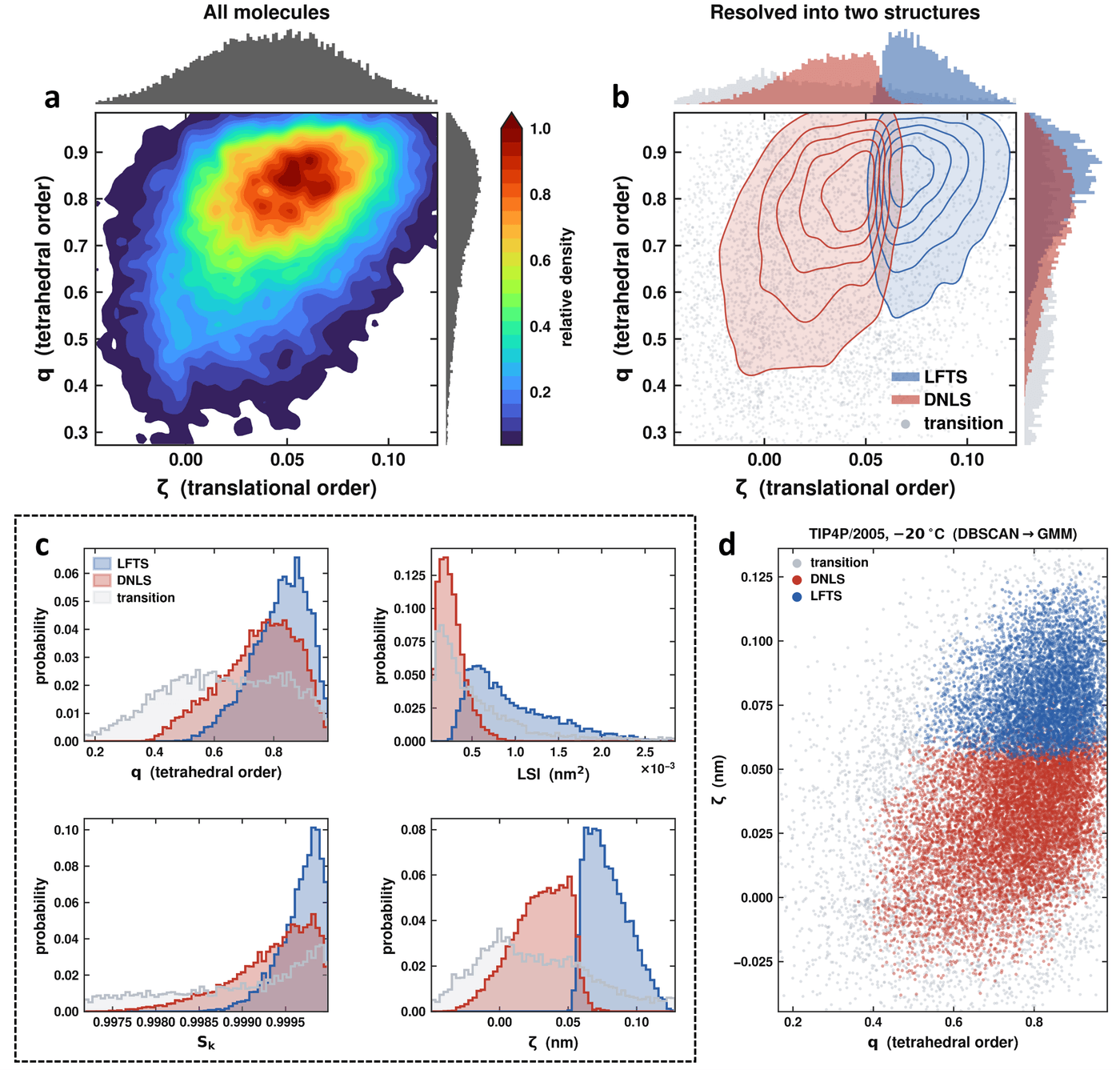
The validation
Clusters are easy to draw and hard to trust. So I tested them against something the clustering never saw: the per-cluster oxygen–oxygen structure factor S(k), computed straight from atomic coordinates. The LFTS cluster peaks at kT1 ≈ 0.81, the DNLS cluster at kD1 ≈ 1.05 — exactly where two-state theory predicts. Since clustering and validation share no descriptor, the agreement is model-independent.3
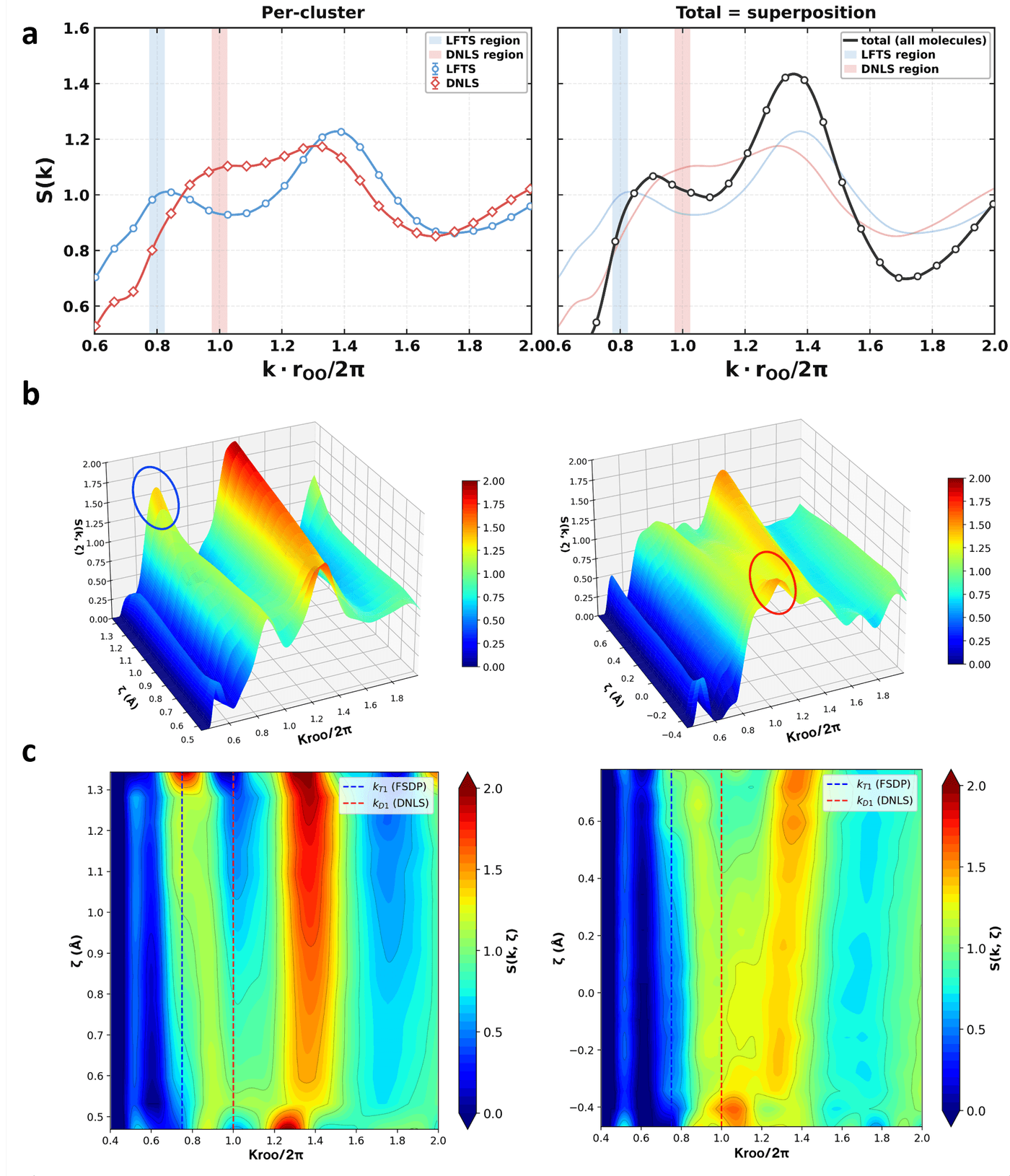
S(k) of real water.Generality
The two-state signature is not an artefact of one model or temperature. It holds from deep supercooling to ambient conditions, and across three independent water models.
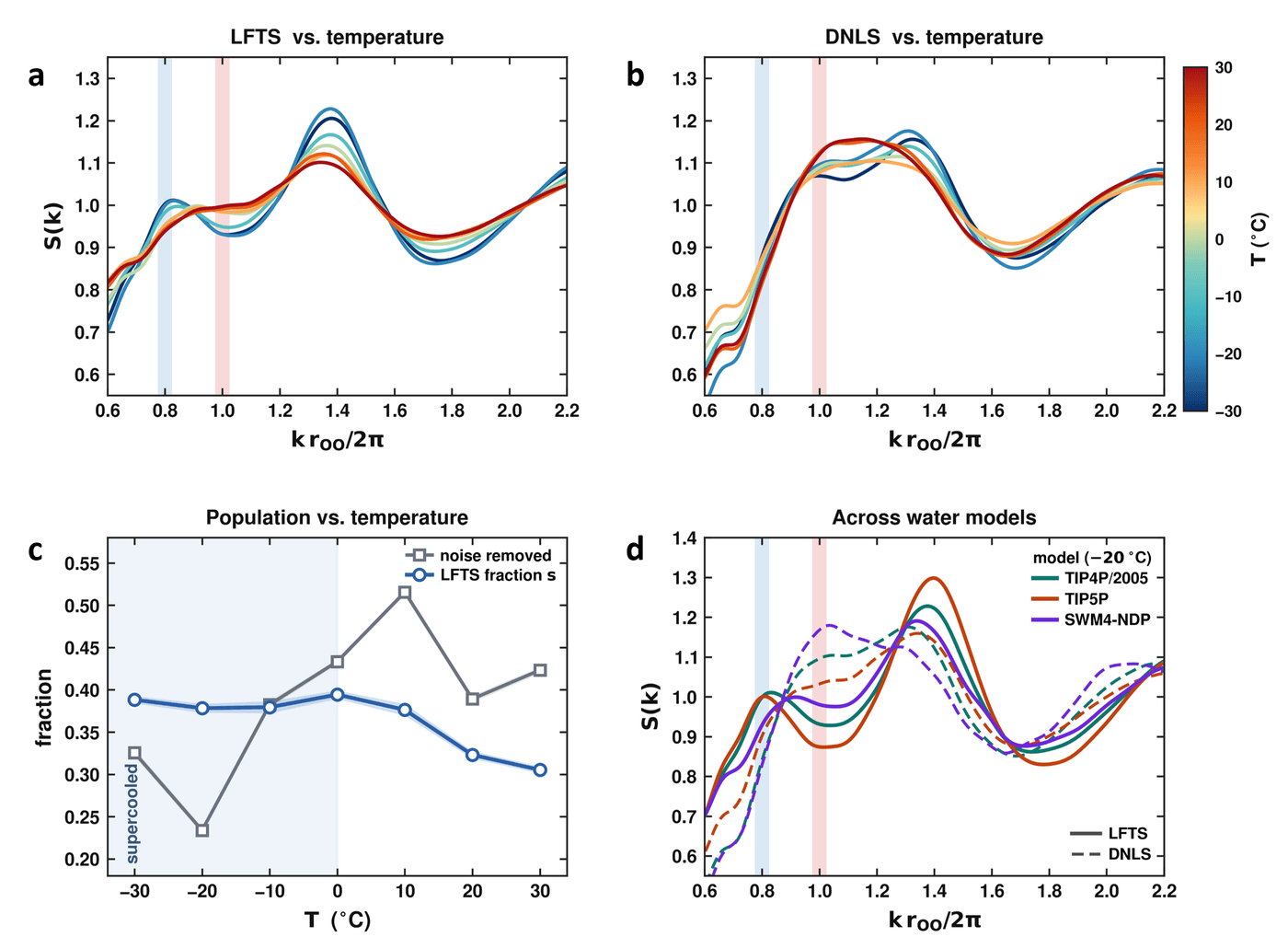
- TIP4P/2005 and TIP5P are rigid, point-charge parameterizations of the water molecule built for molecular-dynamics simulation — along with SWM4-NDP, the third model used in the generality check below, these are three independently developed descriptions of the same substance.
- DBSCAN is a density-based clustering step that strips out sparse, ambiguous points without requiring a fixed cluster count in advance; the GMM (Gaussian mixture model) that follows then fits soft, probabilistic memberships to whatever populations DBSCAN leaves behind.
- “Model-independent” here means the same two-population split shows up whether you look at the four order parameters used to build the clusters or at S(k) computed straight from atomic coordinates — since the clustering step and the validation step never share a descriptor, one can't have quietly leaked into the other.
- The two-state framing tested here follows the Shi & Tanaka hypothesis for structural heterogeneity in liquid water.
- Code and analysis: github.com/OhhMoo/Water_Clustering